Intrinsic terms
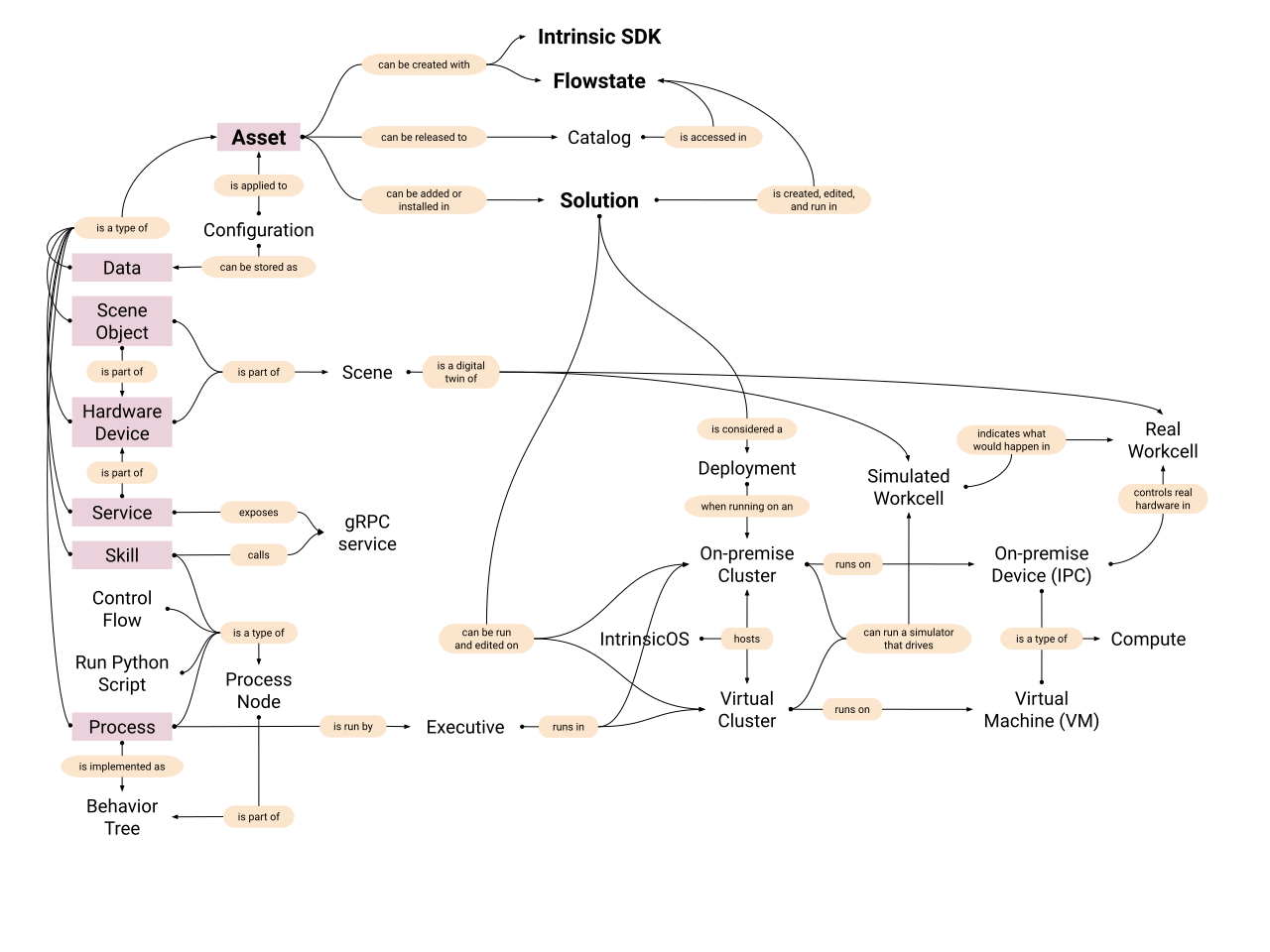
This glossary contains Intrinsic-specific terminology. It includes terms that have a wider meaning in external literature but have specific and refined semantics for Intrinsic (e.g., skill). It also includes product names and associated terms for parts of the Intrinsic platform (e.g., ICON action). The following diagram summarizes relationships between most of the items in this glossary:
Access control list (ACL)
A collection of user/user group and role pairings associated with various features of the platform, including access to packages or assets and administrative functions.
Asset
A self-contained digital entity that can be installed in and reused across solutions. Types of assets include scene objects, services, hardware devices, skills, processes, and data. Assets are associated with a package, and can be released to a catalog.
Behavior tree
A way of implementing a process as a tree data structure. It is composed of process nodes that are parsed and executed by the executive. Behavior trees are parameterizable and may be made reusable as their own process nodes, nestable in other processes.
Catalog
A database that holds assets intended for reuse between users or organizations. assets in the catalog are versioned, immutable, and shareable according to access control lists (either on individual assets or their containing packages) that grant roles to user groups.
Cloud cluster
A Kubernetes cluster running in the cloud that is used to centrally manage a fleet of on-premise clusters (on on-premise devices). Some functionality of the on-premise clusters depends on functionality provided by the cloud cluster; for example, storage of the catalogs or certain cloud-based services such as ML training, monitoring, and update management.
Compute
The computing resources on which IntrinsicOS runs and hosts a Kubernetes cluster, in which platform services and installed software containers (e.g., skills and services) are run for a particular solution. These are either cloud-based virtual machines for editing, simulation, and testing, or on-premise devices used for editing, simulation, testing, and interaction with real workcells.
Configuration
A set of parameters provided by the user for an asset instance. Some configuration parameters may be required, and others optional, in which case there may or may not be a default value provided by the asset author.
Control flow
A type of process node that controls the executive’s progress through a process. Examples of control flow include sequential, parallel, repeated, or conditional execution.
Data asset
A type of asset that stores a set of values, possibly including references to other files. Data assets can, for example, represent a perception ML model, or configuration values for another asset.
Data flow
The directed movement of information between skills. Each skill can produce output data that serves as input for subsequent skills.
Deployment
An instance of a solution running on an on-premise device. Running one solution on multiple on-premise devices results in multiple deployments.
Digital twin
A virtual representation of a real workcell entities, including scene objects, hardware devices, or entire scenes. It serves as the associated entity's digital counterpart for practical purposes, such as system simulation, integration, testing, monitoring, and maintenance.
Executive
The platform service responsible for executing a solution’s user-specified process (implemented as a behavior tree consisting of process nodes).
Flowstate
The graphical web-based environment used to build, test, and run solutions consisting of assets (e.g., scene objects, hardware devices, processes, etc). Solutions can be created, edited, and simulated in Flowstate on any type of compute, and can control a real workcell if run on an on-premise device.
Geometry
The underlying mesh, points, and frames that make up a scene object.
Hardware device
A type of asset composed of one scene object and one or more services. It represents the digital twin of a real workcell entity that has both physical and behavioral (i.e., software) aspects; i.e., performing perception and/or action.
Hardware driver modules
A set of Intrinsic-provided service assets that work with the real-time control service to interface with specific robot or device brands, protocols, or fieldbuses.
ICON action
The fundamental software building block for robot control in the real-time control framework. ICON actions encode real-time robot behaviors. Skills can call, configure, and run custom ICON actions in the real-time control service from a non-real-time context, and have them executed in a real-time control loop.
IntrinsicOS
The operating system (OS) that orchestrates all aspects of a running solution on an on-premise or virtual cluster. It uses Kubernetes to distribute, manage, and operate containerized software.
Intrinsic Real-Time Control Framework (ICON)
A part of the Intrinsic platform that executes real-time robot motion and sensor-based control, and supports the integration of new real-time hardware. It includes the real-time control service, a set of hardware driver modules, and APIs for developing new hardware driver modules.
Intrinsic SDK
The collection of APIs, command line tools, build system, dev container, and VS Code plugin that allow a software developer to create, test, and manage certain types of assets (e.g., skills and services) and author processes via the Solution Building Library.
Node
See process node.
On-premise cluster
A Kubernetes cluster hosted by IntrinsicOS, running on an on-premise device. It can be used for editing or simulating a solution (in the same way as on a virtual cluster) but has the additional capacity to run a deployment on the associated real workcell.
On-premise device
A physical hardware compute device that runs IntrinsicOS, which hosts an on-premise cluster. The on-premise device is connected to a real workcell. It can also be referred to as an Industrial PC (IPC).
Organization
An entity representing one or more affiliated users; typically a company or institution. Organizations are granted data storage, a package string used to identify their assets, and the ability to administer their users/user groups. Billing occurs at the organization level.
Package
A string used as a prefix in the identifier for an asset. Each organization chooses a package, which is recommended to be a reverse DNS of their URL, during onboarding. assets created by users of that organization are associated and identified with the package. Packages can also be used as a hierarchical grouping to grant blanket roles over all contained assets.
Permission
The ability for a user/user group to perform particular actions on or with assets or other platform entities. Permissions are not granted directly, but are collected into roles, which can be associated with users/user groups in a package’s or asset’s access control list.
Process
An asset type that defines a robot automation task. A process in Flowstate is implemented as a behavior tree composed of process nodes.
Process node
An entity in a process that represents either control flow (e.g., sequential, parallel, repeated, or conditional execution) or units of perception, computation, or action (e.g., skills built as software containers, run python scripts, or behavior trees).
Real-Time Control Service (RTCS)
An Intrinsic-provided service for performing real-time control of robots and devices on real-time fieldbuses or protocols.
Real workcell
All physical entities that comprise an automation solution. This includes robots, end-of-arm tooling, cameras, on-premise devices, safety equipment, and the enclosure.
Role
A collection of permissions that can be granted to users/user groups on a package or asset in an access control list, or on a platform action (e.g., related to management of an organization, its users/user groups, its assets/packages, its solutions, or its real workcells).
Scene
A geometric representation of a real or simulated workcell, consisting of instances of scene objects in a particular kinematic configuration. A scene may describe the initial state of a workcell or an in-progress snapshot of the workcell in the midst of a running process.
Scene object
Geometric models representing real, physical entities. They can store visual and collision geometries as polygonal meshes; helper frames or tool paths; kinematic joints and linkages; and metadata or configuration data (e.g., material properties, symmetry information, the intrinsic parameters of a camera, or the kinematic properties of a robot such as joint position, velocity, and acceleration limits).
Service
An asset type that encapsulates arbitrary software in a container that runs alongside the executive (which runs a process) in a running solution. It exposes gRPC services and is thus accessible to skills and other services. Services may perform computation or interact with other systems over the network or on fieldbuses.
Simulated workcell
A scene that is loaded into a simulator (running on either an on-premise or virtual cluster) that reflects, to some degree of physical and visual fidelity, the effects of a running solution and can provide input back to that solution. To the extent that the scene is an accurate digital twin of a real workcell, the simulation indicates what should happen when the solution is run on that real workcell.
Skill
An asset type that encapsulates a particular automation behavior with the ability (but not requirement) to be associated with other assets, such as services. It is leveraged as a building block of robot behavior while authoring a process.
Skill footprint
The predicted set of utilized resources (including required services, the spatial volume occupied or traversed, and nominal time required) by a skill during its execution. For example, the footprint of a joint move on a robot consists of the robot hardware, its associated end-effector, the swept volume of the joint move, and the time it takes to move.
Skill prediction
Given a set of parameters and a scene, the predicted output of a skill and its expected effect on the real world.
Solution
The data structure containing the combination and configuration of assets and scenes to realize an automation task. Software-based assets like behavior trees, skills, and services contain code that will run in the course of a process, while other assets like hardware devices and scene objects describe the real workcell in which that code will run. A solution can be edited and run on a virtual cluster (in simulation only) or on an on-premise cluster (where it can either run in simulation or cause interaction with a real workcell).
Solution Building Library (SBL)
A Python library in the Intrinsic SDK that allows the programmatic creation of solutions and processes.
Solution example
A solution provided by Intrinsic that can be copied and used as a starting point for a new solution.
User
An individual who has access to Flowstate and to solutions and assets built on the Intrinsic platform.
User group
A collection of users and other user groups, to which roles can be granted in access control lists associated with packages, assets, and other platform entities. They may be created by an organization’s administrators.
Virtual cluster
A Kubernetes cluster hosted by IntrinsicOS, running on a virtual machine. It can be used for editing or simulating a solution, but not for running a deployment that interacts with a real workcell.
Virtual machine (VM)
A cloud-based compute resource allocated on demand to run a virtual cluster.